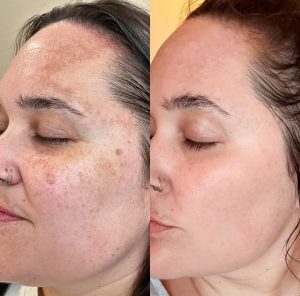
After Sunburn: How to Care for Your Skin Now, and When Marks Can Be Treated
A bad burn on holiday, a forgotten afternoon in the garden or years of repeated burning can all leave their mark. Some people are left with uneven patches or darker spots long after the redness has gone. If you’re wondering about sunburn pigmentation treatment Cheadle clinics offer, the most important thing to understand is timing. Burnt skin needs to heal first, and treatment comes much later. This guide explains what to do straight after a burn, when it’s time to think about marks, and how pico laser treatment fits in.
First: Looking After Burnt Skin
Treatment for pigmentation never starts on freshly burnt skin. First, the burn needs proper care.
Sunburn is hot and sore skin caused by too much sun, and it may flake and peel after a few days. It can usually be treated yourself and tends to get better within 7 days. wales
What helps:
- Get out of the sun as soon as possible. wales
- Cool your skin with a cool shower, bath or damp towel. wales
- Apply aftersun cream or spray, or an unperfumed moisturiser. wales
- Avoid alcohol and drink plenty of water to cool down and prevent dehydration. wales
- Cover sunburnt skin from direct sunlight until it has fully healed. wales
What to avoid:
- Don’t use petroleum jelly on sunburnt skin, and don’t pop any blisters. wales
A pharmacist can recommend products. If the burn is severe, widespread or blistering, please get medical help. Severe sunburn can lead to heat exhaustion and heat stroke, which can be very serious, and a baby or young child with sunburn needs an urgent GP appointment or NHS 111. wales
Sunburn on Brown and Black Skin
On white skin sunburn usually looks red or pink, but on black or brown skin you may not notice a change in colour. That doesn’t mean the skin hasn’t been damaged. If your skin feels hot, sore or tight after sun, treat it as sunburn, even if it doesn’t look red. wales
What Can Be Left Behind
Once the burn has healed, some people notice that their skin doesn’t quite return to normal. Depending on the person, and on how often they’ve burnt, they may see:
- freckles that look darker or more numerous
- sun spots or age spots that have built up over the years
- uneven, patchy colour on the shoulders, chest, back or face
- darker patches after peeling has finished
Some of this is temporary and gradually settles. Some, particularly from repeated burning over many years, tends to stay. A proper look at your skin tells us which is which.
The Most Important Step: Check First
Sun damage and moles need different attention. If a mark is new, raised, itchy, bleeding, uneven in colour or changing, please see your GP before any cosmetic treatment. Cancer Research UK advises seeing your doctor if you notice a change to a previously normal patch of skin. If you’ve had repeated burns in the past, regular skin checks are a good habit. Angel will always recommend a medical check first if she isn’t sure about a mark. cancerresearchuk
When Can Pigmentation Be Treated?
We never treat burnt, peeling or freshly tanned skin. Before pigmentation treatment, we’d expect:
- the burn to be completely healed, with no redness, soreness or peeling
- any tan to have faded
- skin to be calm and not irritated
- you to be willing to protect the area from the sun afterwards
Because everyone’s skin heals at a different pace, we’ll assess yours at your consultation and tell you when it’s sensible to begin.
How Pico Laser Treatment Works
At Angel Skin Lab we use a pico laser to treat pigmentation. It delivers energy in extremely short pulses, which break the excess pigment into smaller fragments. Over the following days and weeks, your body clears the fragments, and the marks gradually lighten.
What to expect:
- Treated spots may look darker, slightly crusty or raised for a few days. Don’t pick, and let them fall away naturally.
- Results appear gradually, over the weeks after each session.
- Some marks need more than one session.
- Treatment can lighten what is there, but it can’t stop new pigment forming if you burn or tan again.
Skin Tone and Safety
Laser energy can also be absorbed by your natural skin pigment, so settings have to be chosen with care, particularly on medium and deeper skin tones, and a patch test may be recommended. We also ask about medication, pregnancy, breastfeeding, skin conditions and your sun exposure, and we may ask you to wait if any of those make treatment unsuitable right now.
Aftercare
- Protect the area from the sun every day with SPF and clothing.
- Don’t pick, scratch or peel any crusting or flaking.
- Keep skin moisturised with a gentle, fragrance-free product.
- Avoid harsh exfoliants, retinol and strong acids until skin has settled.
- Skip saunas, steam rooms and intense exercise for a day or two.
- Contact us if anything worries you.
Preventing the Next Burn
Protection is the best treatment. The NHS advises a sunscreen with an SPF of at least 30 and at least 4-star UVA protection, applied generously around 30 minutes before going out and reapplied frequently. It also stresses that sunscreen alone isn’t enough, so cover up with clothes, a hat and sunglasses, and seek shade. wwwwww
Avoid sunbeds as well. UV from a sunbed is still UV, and it can cause the same pigment problems.
What About Home Remedies for Marks?
Lemon juice, scrubs and strong DIY mixtures aren’t a safe way to lighten pigmentation. They can irritate skin and can sometimes make marks darker. A pharmacist can advise on suitable products, and daily broad-spectrum sunscreen is the most useful thing you can do at home.
What Happens at a Consultation
Angel will look at your skin, ask about your sunburn history and when you were last burnt, and check your skin tone and health history. She’ll tell you honestly what type of marks you have, whether treatment is suitable now or whether it is better to wait, and what results are realistic. There is no pressure to book on the day.
Book Your Consultation
If sun damage has left uneven tone or darker marks, come and talk it through. Whether you’re searching for sunburn pigmentation treatment Cheadle and Stockport clients can trust, or you simply want to know when it is safe to treat your skin, start with a conversation. For NHS information, read the guide to sunburn and the NHS guide to sunscreen and sun safety.
📍 Angel Skin Lab, Suite S61, Bizspace Cheadle Place, Stockport Road, Cheadle, Stockport, SK8 2JX
📞 Call/text/WhatsApp 07889467434
🌐 angelskinlab.co.uk
https://angelskinlab.co.uk/dermis-pigmentation-laser-removal/
https://www.swbh.nhs.uk/wp-content/uploads/2012/07/Laser-treatment-for-pigmented-marks-ML5169.pdf