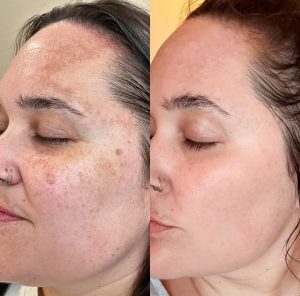
Understanding Melasma, Freckles, Sun & Age Spots
Uneven skin tone can develop for many different reasons. You may notice darker patches after spending time in the sun, small freckles across the face, age-related pigmentation or areas of discolouration left behind after repeated sun exposure.
For some people, pigmentation is barely noticeable. For others, it can become one of the main things they see when looking in the mirror.
At Angel Skin Lab in Cheadle, we understand that pigmentation is not always straightforward. Different types of discolouration can behave differently, which is why identifying the appearance and likely cause of the pigmentation is an important part of deciding whether a laser-based approach is appropriate.
What can cause pigmentation?
Pigmentation refers to changes in the colour of the skin. Increased melanin production can leave areas looking darker than the surrounding skin.
Common concerns include:
- Melasma or chloasma
- Freckles
- Sun-related pigmentation
- Age spots
- Uneven skin tone
- Darker areas following previous sun exposure
- Some forms of pigmentation associated with inflammation or skin irritation
Sun exposure is particularly important because ultraviolet radiation can stimulate melanin production. Even if your skin appears to recover after a sunburn, repeated exposure over the years can contribute to persistent uneven pigmentation and visible signs of sun damage.
This is why protecting your skin from UV exposure is an important part of managing pigmentation — not simply something to consider after treatment.
Melasma and chloasma require particular care
Melasma, sometimes referred to as chloasma, can appear as larger brown or grey-brown patches, commonly across areas such as the cheeks, forehead, upper lip and nose.
Unlike an isolated sun spot, melasma can be influenced by several factors, including hormonal changes and UV exposure. It can also be persistent and may return after improvement.
Importantly, not every person with melasma is automatically suitable for laser treatment. Certain laser and light-based procedures can potentially aggravate melasma in some individuals.
That is why a proper consultation and skin assessment are essential before deciding on a treatment approach. At Angel Skin Lab, the aim is to understand your pigmentation concern rather than simply treating every dark patch in the same way.
What about freckles and sun spots?
Freckles are small areas of increased pigmentation that are often more noticeable after sun exposure. They can naturally become lighter during periods of reduced UV exposure and darker during sunnier months.
Sun spots and age spots can also develop after cumulative exposure to ultraviolet radiation. These may appear as flat, darker areas on commonly exposed areas such as the face, hands, chest and arms.
For selected pigmentation concerns, laser technology may be considered as part of a personalised treatment plan.
However, results vary from person to person. Pigmentation type, skin tone, depth of pigment, previous sun exposure and aftercare can all influence the response.
What about pigmentation after sunburn?
A sunburn itself is not something that should be treated with a cosmetic laser while the skin is actively damaged, inflamed or healing.
If you have recently experienced significant sun exposure, your skin needs time to recover. Once the skin has healed, any remaining pigmentation can be assessed separately.
This distinction is important. Treating irritated or recently sunburned skin without appropriate assessment could increase the risk of unwanted reactions.
Why a consultation matters
Pigmentation is not simply a case of finding a darker area and applying a treatment.
A professional assessment can help determine whether the concern appears suitable for treatment, whether other options may be more appropriate and whether there are factors that could affect your skin’s response.
Any new, changing, irregular, bleeding or unusual pigmented lesion should be assessed by an appropriate medical professional before cosmetic treatment. Cosmetic pigmentation treatment should never replace medical assessment where there is uncertainty about a skin lesion.
Your skin still needs protection afterwards
If you are addressing pigmentation, protecting your skin from further UV exposure is essential.
A broad-spectrum sunscreen, sensible sun protection and avoiding unnecessary tanning can help reduce ongoing UV exposure. Without good sun protection, new pigmentation may develop even after an area has improved.
Think of treatment as one part of a longer-term skin plan rather than a permanent solution to future pigmentation.
Looking in Cheadle or Stockport?
If you are concerned about melasma, freckles, sun-related pigmentation, age spots or uneven-looking skin tone, Angel Skin Lab in Cheadle can discuss your concerns and assess whether a laser-based approach may be suitable for you.
Located conveniently for clients from Cheadle, Stockport and South Manchester, Angel Skin Lab provides personalised aesthetic treatments with an emphasis on careful assessment and appropriate treatment planning.
📍 Angel Skin Lab
Suite S61, Bizspace Cheadle Place
Stockport Road
Cheadle
SK8 2JX
📞 07889 467 434
If you are unsure whether your pigmentation is suitable for treatment, get in touch to arrange a consultation and discuss your skin concerns before deciding on the next step.
laser pigmentation removal Cheadle, hyperpigmentation treatment Cheadle
https://www.swbh.nhs.uk/wp-content/uploads/2012/07/Laser-treatment-for-pigmented-marks-ML5169.pdf
https://angelskinlab.co.uk/dermis-pigmentation-laser-removal/